Where AVC32 fits in the air vent range
AVC32 is a model-level route inside the wider air vents and air eliminators range. It suits steam-system users who have already moved from a category search to model selection, particularly for higher-pressure mains or installations that call for welded or flanged connections.
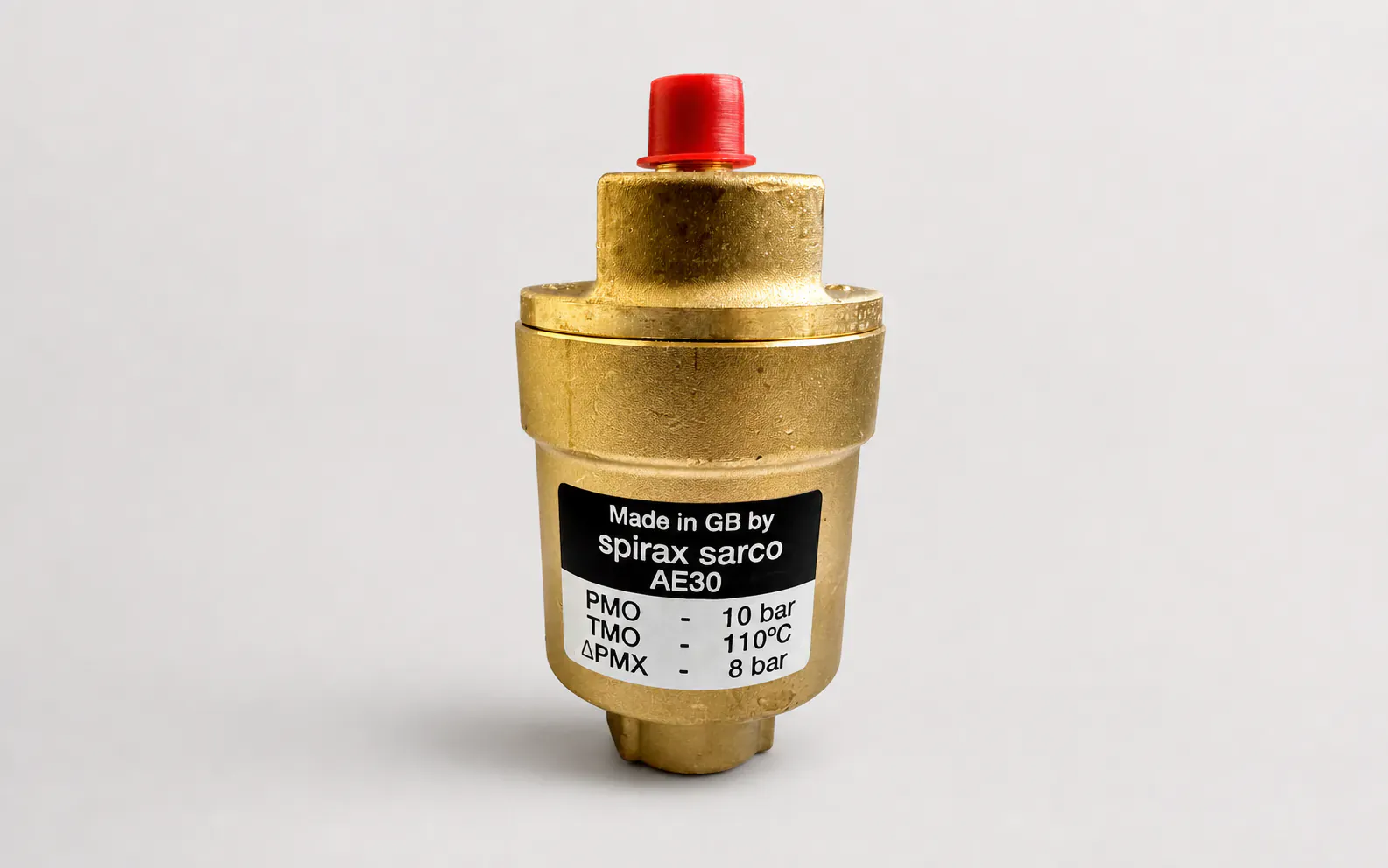
Within the same air vent range, AVC32 and the brass AV13 form a high/low pairing by material and pressure class. AV13 is oriented toward lower-pressure threaded applications, while AVC32 offers a carbon steel body, higher operating pressure and socket weld, butt weld or flanged connections for steam mains.
Product facts
Available technical material (TI-P123-15) confirms the following:
AVC32 is a maintainable carbon steel balanced-pressure thermostatic air vent for steam systems- It includes an integral flat strainer screen and straight connections for direct in-line installation
- The body, flanges and cover are carbon steel; the capsule, valve seat, strainer screen and spring are stainless steel
- Pressure-bearing components are made by
TÜV-approved suppliers to AD-Merkblatt WO/TRD100 - It complies fully with the Pressure Equipment Directive
2014/68/EU, with EN 10204 3.1 certification available - The cold
Kv value is 0.8 for all sizes
Technical data summary
| Item | Value |
|---|
| Body material | Carbon steel (DIN 17243 C22.8 / ASTM A105N) |
| Internal materials | Stainless steel (capsule, valve seat, strainer screen, spring) |
| Sizes | 1/2”, 3/4”, 1” (DN15, DN20, DN25) |
| Maximum allowable pressure PMA | 50 bar g @ 50 °C |
| Maximum allowable temperature TMA | 400 °C @ 35 bar g |
| Minimum allowable temperature | -60 °C |
| Maximum operating pressure PMO (saturated steam) | 32 bar g |
| Maximum operating temperature TMO | 287 °C @ 32 bar g |
| Minimum operating temperature | 0 °C |
| Cold hydraulic test pressure | 75 bar g |
AVC32 is also safe to use under full vacuum conditions.
The connection formats covered by the technical material include:
- Screwed
BSP T Rp (ISO 7-1) or NPT - Socket weld ends to
BS 3799 - Butt weld ends to
EN 12627 - Flanged to
EN 1092 PN40, ANSI B16.5 Class 150 and 300, and JIS/KS 10K and 20K
The complete-unit specifications currently selectable at the top of this page focus on 1/2", 3/4" and 1" threaded BSP connections. Confirm welded or flanged requirements against site conditions before ordering.
Installation and selection checks
AVC32 should be installed at the highest point of a steam main or item of equipment, where air collects most readily, with the capsule horizontal and the cover at the top. The discharge should be piped to a safe place, and the air vent itself must not be insulated. Fit isolation valves upstream and downstream to allow future maintenance.
Before specifying AVC32, confirm:
- Whether the site connection is threaded, socket weld, butt weld or flanged, and the relevant connection standard
- Whether a
1/2", 3/4" or 1" size is required - That the operating pressure is within the
32 bar g saturated steam range - That the installation point is a genuine air-collection high point and the capsule can be mounted horizontally
- That isolation valves are provided upstream and downstream for in-line maintenance
- That the discharge can be safely routed away from personnel and equipment
Technical documentation coverage
TI-P123-15 covers the material construction, pressure and temperature limits, sizes and connection formats, Kv value, dimensions and spare parts for AVC32. Installation, maintenance and tightening torque detail is provided in the accompanying installation and maintenance guide (IM-P123-14).
Which steam-system applications AVC32 suits
Where the site problem centres on slow warm-up of higher-pressure steam mains, reduced heat transfer, gas accumulation in the steam space, or equipment high points that need continuous removal of non-condensable gases, and the connection format calls for welding or flanges, a carbon steel thermostatic air vent like AVC32 is generally a closer fit than a brass threaded model.
For lower-pressure systems based mainly on threaded connections, you can return to air vents and air eliminators to compare AV13 and other routes.