Compare the wider regulator family
Return to the wider pressure reducing and surplussing valve route when you need to compare BRV2S with 25P, DP27, BRV7 or other self-acting pressure control formats.

Control systems > Pressure reducing valves
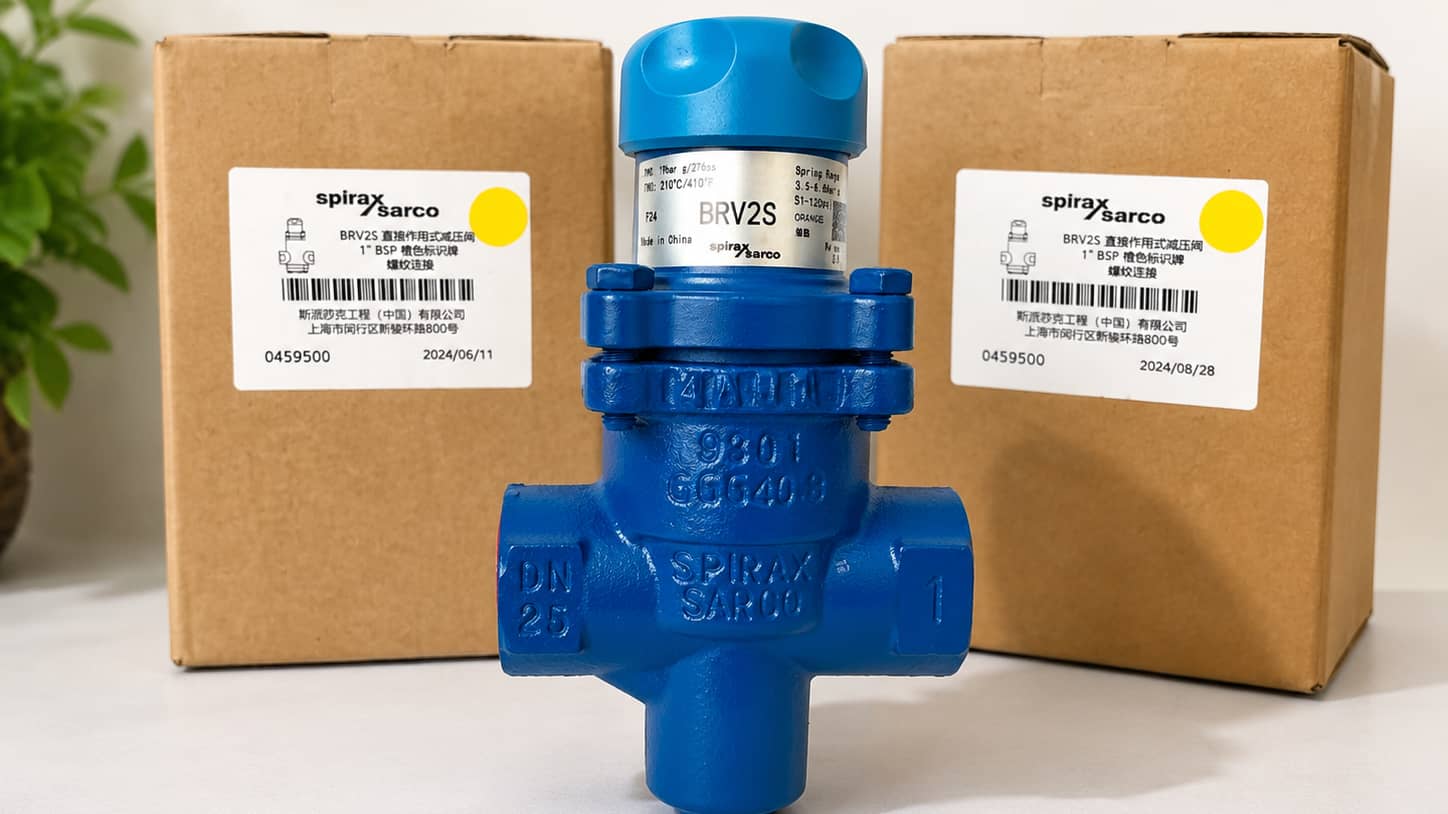
Spirax Sarco BRV2S Direct Acting Pressure Reducing Valve
BRV2S is positioned as a compact direct acting Spirax Sarco pressure reducing valve for steam and compressed air duties where users already know the model and need a clearer route into product review, replacement planning and station design checks.
Quick facts
Within the current Spirax Sarco pressure reducing range, BRV2S belongs to the compact BRV2 family that sits closer to point-of-use duties than larger pilot-operated station valves. The English and US product brochures both position BRV2 as a compact option inside the wider self-acting regulator range, which helps users who already know the designation move beyond the family overview.
This matters because a BRV2S search is usually not a broad educational query. It is more often a replacement, installed-base or product-recognition task where the user wants direct confirmation of what the model is, what media it supports and what station checks still matter before specifying it.
Technical information and installation documentation confirm these BRV2S selection points:
BRV2S is a direct acting pressure reducing valveBRV2S variant uses a ductile iron body with stainless steel bellows1/2 in, 3/4 in and 1 in screwed BSP or NPT, plus DN15, DN20 and DN25 flanged EN 1092 PN258.6 bar g19 bar, with a recommended maximum reduction ratio of 10:1The product documentation also confirms adjacent variants such as BRV2B, BRV2SP and BRV2BP, which is useful when the installed valve is recognised as part of the wider BRV2 family rather than by one exact suffix only.
This product path acts as the bridge between product recognition and selection context. It helps users confirm where BRV2S fits relative to pilot-operated options like 25P and larger compact alternatives like BRV7, while keeping the discussion grounded in documented facts rather than guessed performance claims.
The documented downstream control ranges are spring-selected in three overlapping bands:
0.14 to 1.7 bar g1.40 to 4.0 bar g3.50 to 8.6 bar gWhere ranges overlap, the product guidance recommends choosing the lower-range spring for better control. That is a practical selection point because BRV2S is intended as a compact self-acting valve, so spring choice and achievable outlet stability matter more than they would on a broad family-only page.
The installation guidance treats BRV2S as part of a full pressure reducing station rather than a standalone inline component. The documented recommendations include:
For externally sensed variants, the product documentation also requires the sensing line to connect at least 1 m downstream. That detail matters when users are comparing BRV2S with BRV2SP or other station layouts.
Even with a documented model path, final selection should still confirm:
BRV2S or an externally sensed BRV2SP route is more appropriateBRV2S selection usually sits inside a wider station decision that also includes upstream steam quality, downstream protection and practical installation layout.
Return to the wider pressure reducing and surplussing valve route when you need to compare BRV2S with 25P, DP27, BRV7 or other self-acting pressure control formats.
Move into the broader control systems range when the project also needs control valves, actuator-led modulation or adjacent pressure-control hardware.
Review strainers, separators, gauges and safety valves when you are building a complete pressure reducing station rather than selecting the valve alone.